
How Livity Calculates Your Fitness Age
Last updated: December 8, 2025
Your fitness age represents your body's biological age based on cardiovascular health, physical activity, and recovery metrics. Unlike your chronological age, your fitness age can improve with lifestyle changes. Livity calculates your fitness age using eight evidence-based health markers drawn from peer-reviewed research involving millions of participants.
Our Approach: Fair & Research-Based
Livity uses a population-neutral methodology. This means if your metrics match the average for your age and sex, your fitness age equals your chronological age—no penalty for being normal.
Your fitness age decreases (you're biologically younger)
Your fitness age increases (room for improvement)
The 8 Factors That Determine Your Fitness Age
Our algorithm analyzes eight scientifically-validated health markers. Each factor is weighted based on its proven impact on mortality and healthspan from large-scale epidemiological studies.
VO₂ Max (Cardiorespiratory Fitness)
Highest Impact FactorVO₂ max measures how efficiently your body uses oxygen during exercise—the single strongest predictor of longevity among modifiable health factors. Your Apple Watch estimates this during outdoor walks and runs.
Research: The Kokkinos et al. 2022 study of 750,302 veterans found VO₂ max to be the strongest predictor of longevity among modifiable health factors, regardless of age, BMI, or health conditions.
Resting Heart Rate (Sleep)
Measured during sleep for accuracyA lower resting heart rate indicates better cardiovascular efficiency. We measure your heart rate during sleep to eliminate daytime stress and activity influences, providing a true baseline reading.
Research: The Zhang et al. 2016 meta-analysis of 46 studies (1.2 million participants) found elevated resting heart rate is associated with increased mortality risk in the general population.
Heart Rate Variability (HRV)
RMSSD measured during sleepHRV measures the variation in time between heartbeats, reflecting your autonomic nervous system health and stress resilience. Higher HRV generally indicates better recovery capacity and cardiovascular health.
Research: The Jarczok et al. 2022 meta-analysis found low HRV is associated with significantly higher mortality risk. We compare your HRV against age-sex percentiles from the Lifelines Cohort (84,772 participants).
Sleep Duration
Optimal range: 7-8 hoursSleep is essential for recovery, hormone regulation, and cognitive function. The relationship between sleep and health follows a U-shaped curve—both too little and too much sleep are associated with health risks.
Research: Yin et al. 2017 meta-analysis found a U-shaped relationship between sleep and mortality—both too little and too much sleep increase health risks, with long sleep actually carrying higher risk than short sleep.
Daily Steps
Age-adjusted targetsDaily movement is one of the most accessible ways to improve your health. The optimal step count varies by age—younger adults benefit from more steps, while older adults see maximum benefits at lower thresholds.
Research: Paluch et al. 2022 Lancet meta-analysis (15 cohorts) found significant mortality reduction with more daily steps. Benefits plateau at 8,000-10,000 steps for adults under 60, and 6,000-8,000 steps for those over 60.
Moderate Activity (Zone 2-3)
WHO guideline: 150 min/weekModerate-intensity activity includes brisk walking, cycling, swimming, or any exercise where your heart rate is 50-70% of maximum. This forms the foundation of cardiovascular health.
Research: Arem et al. 2015 (661,137 participants) found meeting the 150 min/week guideline provides substantial mortality reduction. Importantly, most of the benefit is achieved at this minimum—you don't need to be an athlete to see major gains.
Vigorous Activity (Zone 4-5)
Bonus factor: 75+ min/weekVigorous activity—running, HIIT, intense cycling, competitive sports—provides additional cardiovascular benefits beyond moderate activity. Your heart rate reaches 70-85% of maximum during these sessions.
Research: Lee et al. 2022 Circulation study (116,221 adults, 30-year follow-up) found vigorous activity provides additional health benefits beyond moderate activity. This is a bonus—you're not penalized for skipping it.
Strength Training
Optimal: 40-60 min/week (2 sessions)Resistance training maintains muscle mass, bone density, and metabolic health. It becomes increasingly important with age to prevent sarcopenia (muscle loss) and maintain functional independence.
Research: Momma et al. 2022 meta-analysis found optimal benefits at around 2 sessions per week, with diminishing returns beyond that. Interestingly, women benefit more from strength training than men. Skipping it entirely carries a penalty due to sarcopenia (muscle loss) risk.
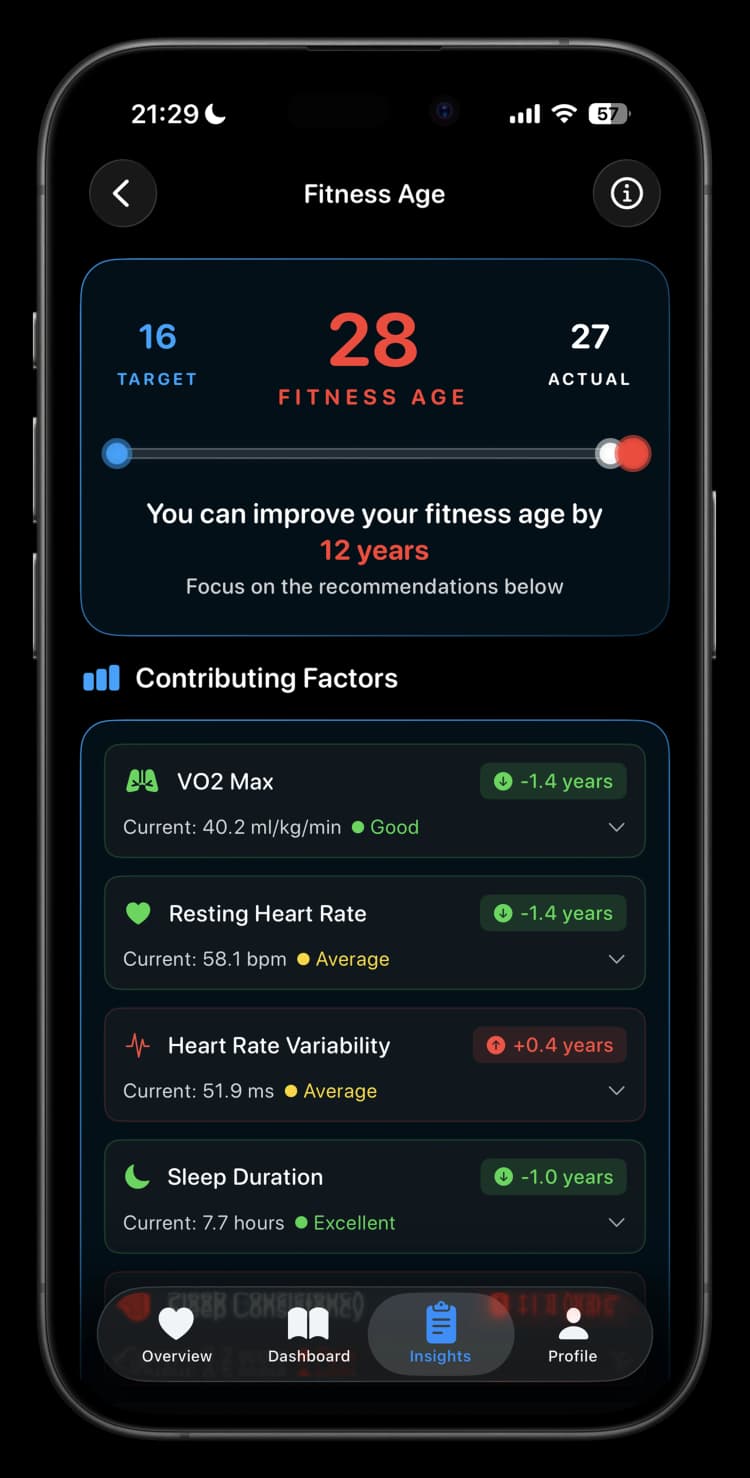
How Your Fitness Age Is Calculated
Your chronological age is the starting point. Each of the 8 factors adds or subtracts years based on how you compare to population averages for your age and sex. Factors are weighted according to their proven impact on health outcomes from peer-reviewed research.
Your fitness age decreases—you're biologically younger than your chronological age.
Your fitness age increases—but this also shows you where to focus for the biggest gains.
The algorithm uses non-linear calculations that reflect real-world health relationships—small improvements in poor metrics have bigger impact than small improvements in already-good metrics.
Pace of Aging: Your Biological Speedometer
Beyond your fitness age, Livity calculates your pace of aging—how fast you're aging biologically compared to chronologically. This is inspired by the DunedinPACE research methodology.
Your Achievable Fitness Age
Livity also shows your achievable fitness age—the realistic best-case scenario if you consistently follow health guidelines. This isn't an elite athlete level; it's based on 75th percentile performance, which is excellent but attainable for most people.
Your achievable age assumes: good cardiovascular fitness, optimal sleep, meeting WHO activity guidelines, 2 strength sessions per week, and age-appropriate daily steps.
Scientific Foundation
Our fitness age calculation is built on peer-reviewed research from leading medical journals:
- Kokkinos et al. 2022 (JACC) — 750,302 veterans, establishing VO₂ max as the strongest mortality predictor
- Zhang et al. 2016 (CMAJ) — Meta-analysis of 46 studies, 1.2M participants on resting heart rate
- Paluch et al. 2022 (Lancet Public Health) — 15 international cohorts on daily steps and mortality
- Arem et al. 2015 (JAMA Internal Medicine) — 661,137 participants on physical activity dose-response
- Momma et al. 2022 (BJSM) — Meta-analysis on strength training and mortality
- Yin et al. 2017 (JAHA) — Sleep duration meta-analysis showing U-shaped mortality curve
- FRIEND Registry — Population-level VO₂ max norms from millions of cardiopulmonary tests
- Lifelines Cohort Study — 84,772 participants providing HRV percentile norms by age and sex
How to Improve Your Fitness Age
Your fitness age isn't fixed—most people can improve it by 3-8 years with consistent lifestyle changes. Focus on these high-impact areas:
🏃 Build Your VO₂ Max
The highest-impact factor. Add 2-3 cardio sessions per week with varying intensities. Even brisk walking helps.
💪 Don't Skip Strength Training
Just 2 sessions per week (40-60 minutes total) provides optimal benefits. Especially important if you're over 40.
😴 Prioritize Sleep Quality
Aim for 7-8 hours consistently. Both too little and too much sleep negatively impact your fitness age.
🚶 Move Throughout the Day
Target 8,000 steps if under 60, 6,000 if over 60. Small walks add up—take calls while walking, use stairs.
Medical Disclaimer
Your Livity fitness age is an educational tool based on population-level research, not a medical diagnosis. Individual results depend on many factors not captured by wearable devices. Always consult healthcare professionals for personalized medical advice, especially before starting new exercise programs.